
Homemade Tomato Cages
It’s time to start planning for summer gardening. Save money and get better quality by making homemade tomato cages!
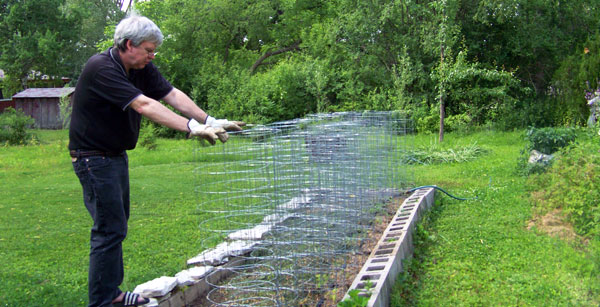
I just had another one of those “why didn’t I think of this before” moments.
Its origins go all the way back to February when I ran out of home canned tomatoes–and months of winter remained. Organic commercially canned tomatoes just don’t taste the same to me, and of course they aren’t local. So this year I resolved to grow more tomatoes. By Memorial Day my plants were ready and all was well.
Until I went out to price tomato cages. Ranging from $2.99 for short flimsy cages to $9.99 (gulp) for pick-your-favorite-color large cages, I was daunted. I had 22 seedlings! Time for homemade tomato cages!

Tomato Seedlings
Now cages aren’t a requirement for growing tomatoes, but I am convinced they work better than letting your tomatoes sprawl, then fighting the slugs for them. And come fall, if we get an early frost (which is often followed by a couple weeks of nice weather), a cage makes a great base for plastic row covering and a serious season extension.
So we resolved to make our own homemade tomato cages. With potato cages under our belt, how hard could this be?
What we did…
John started with a large roll of 4 ft by 50 ft galvanized wire. Because our raised beds are four feet wide, we decided to go with cages that are about 15 inches in diameter to have room for three rows. The mesh sections were two inches wide by four high which should work for our Roma tomatoes. Beefsteak and other large slicers would need larger openings.
Directions
1. For the easiest mass production, count off mesh sections to equal 52 inches (counting is easier than measuring–in our case this was 26 sections, but this may be different if your mesh size is larger–see tip below) and cut in the middle of the following section. The cut pieces on each side will be folded back to secure the cage.
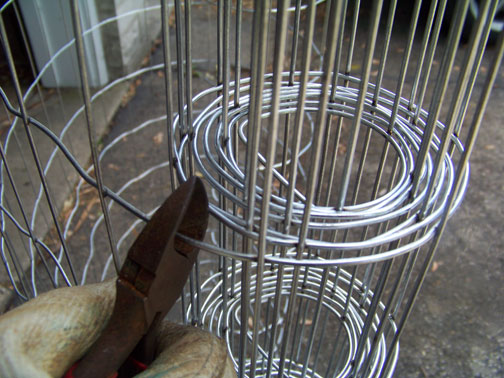
Cut Wire to Size
“Pre-bend” the cut pieces (one side toward you, one side away) to make securing them easier. Form the wire into a tube, overlapping by two sections for strength, then secure the cut pieces.
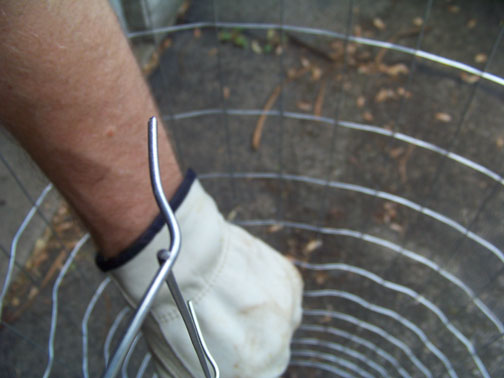
Pre-Bend Cut Ends for Easier Fastening

Bend Cut Ends to Fasten Cages
Snip off the bottom ring of the cage to create anchor wires, so you can push the cage into the ground.

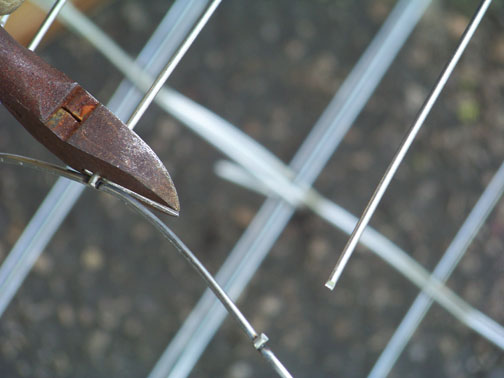
Where the sections overlap, twist the dual anchor wires together to further bind the cage together.
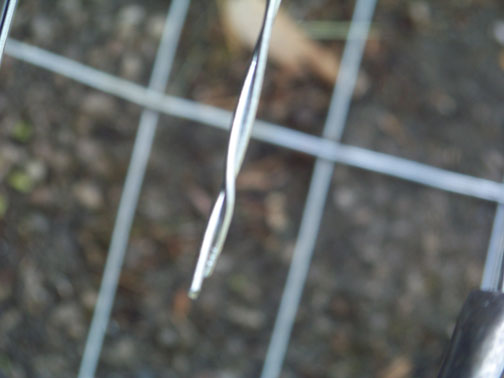
Twist Wires to Further Secure
Insert cages around tomatoes and feel proud. Harvest will be here before you know it!
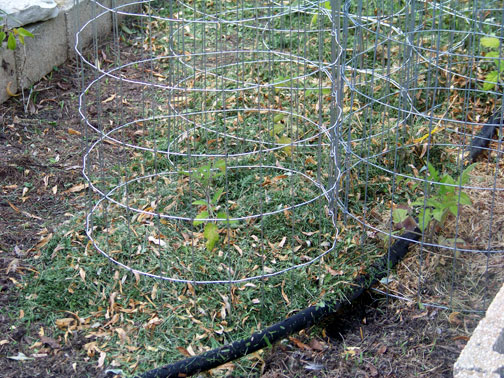
Set Homemade Tomato Cages Over Plants
Accounting
The wire was on sale and came to approximately $28/roll including tax. It made 11 4-foot tomato cages which comes to about $2.50 apiece for a high-end tomato cage, a significant savings over the commercial (and these were better quality than most). At two rolls, this was still an investment, but they will last for years.
This took John about an afternoon to complete—about the time I would have spend debating and researching the best prices for store-bought cages. When I worked in corporate America, we had a saying, “Better, Faster, Cheaper: You can have any two.” In this case, I think we got all three!
Tip: As of the end of the tomato season, these have worked well. The one thing I might do differently is use a larger mesh. If you do two across, you need to reach in elbow deep to get the far tomatoes. I can manage with this size mesh but my husband could get stuck 😉
Concrete reinforcing mesh has 4 inch square openings and also comes in 50-ft rolls. About $50/roll where I live.
You can cut an opening in your existing cages, too! Stagger them a bit and you’ll always have a spot to reach in and pull out the big ones without losing strength.
Awesome tips–thanks Carol!
Pingback: Organic Gardening Homemade Tomato Cages
To accommodate larger hands and to harvest larger fruit, just use your snips to cut a square in the wire.
Ooo, saw this late, but that’s a great idea Mitzi. I may have to “widen” a few openings this summer. Thanks for commenting!
Very nice…I think I might even be able to do this (and that’s saying a lot, lol)
I understand. That’s how I feel about decorating cookies 😉
It’s fun to scrounge around construction sites for leftover pieces of wire. Recycling materials saves even more money! We have also made a henhouse out of discarded fence boards and an old scrap of galvanized roofing.
Wow–great money saver. You know I wonder if someone on Freecycle might also have materials if asked too.
Wow Inger, that’s some tomato patch you have going on there!!! I LOVE the idea that you “guys” made your own tomato cages. Very impressive, and inexpensive too in the long run. I’m not growing tomatoes this year as of yet, but, that may change.
Thank you so much for sharing…Give that hubby of yours an extra helping the next time you cook up that bounty!!!
You know I think he’d like the food even more than a nice cold beer!
Forwarding to my mother for her garden!
How nice to have a mother with a garden!
I’m new to tomato cages, I keep seeing them on other peoples blogs, and have been merrily admiring them. I just use canes, but both the plants and the canes get unruly towards the end of the season and I can see how these would work. So I’m impressed with your version – nice and cheap and practical. I think if I were to do this I’d buy the plastic coated wire as I find the sea air very corrosive!
Years ago I used to stake and tie my tomatoes, but they kept getting away from me (probably not surprising from a woman who forgot to plant her peppers this year). I do hear how hard being near the sea can be on everything–in some ways a nice problem to have to deal with if it gets you the sea!
These casges are a wonderful idea – our tomato plants are always going haywire 😀
Cheers
CCU
And who wants haywire tomato plants! 😉
My husband has two tomato plants growing, and he, too, used cages like yours which he had in storage from an earlier tomato harvest! Loved your post and pictures. Great idea!
Thanks, we were pleased with how they turned out–though I do have this recurring nightmare of growing giant Romas that won’t fit through the cage wires;-)